
What No One Tells You About Graduation Day
On joy, grief, and learning to see the whole student.
By Kera Sanchez
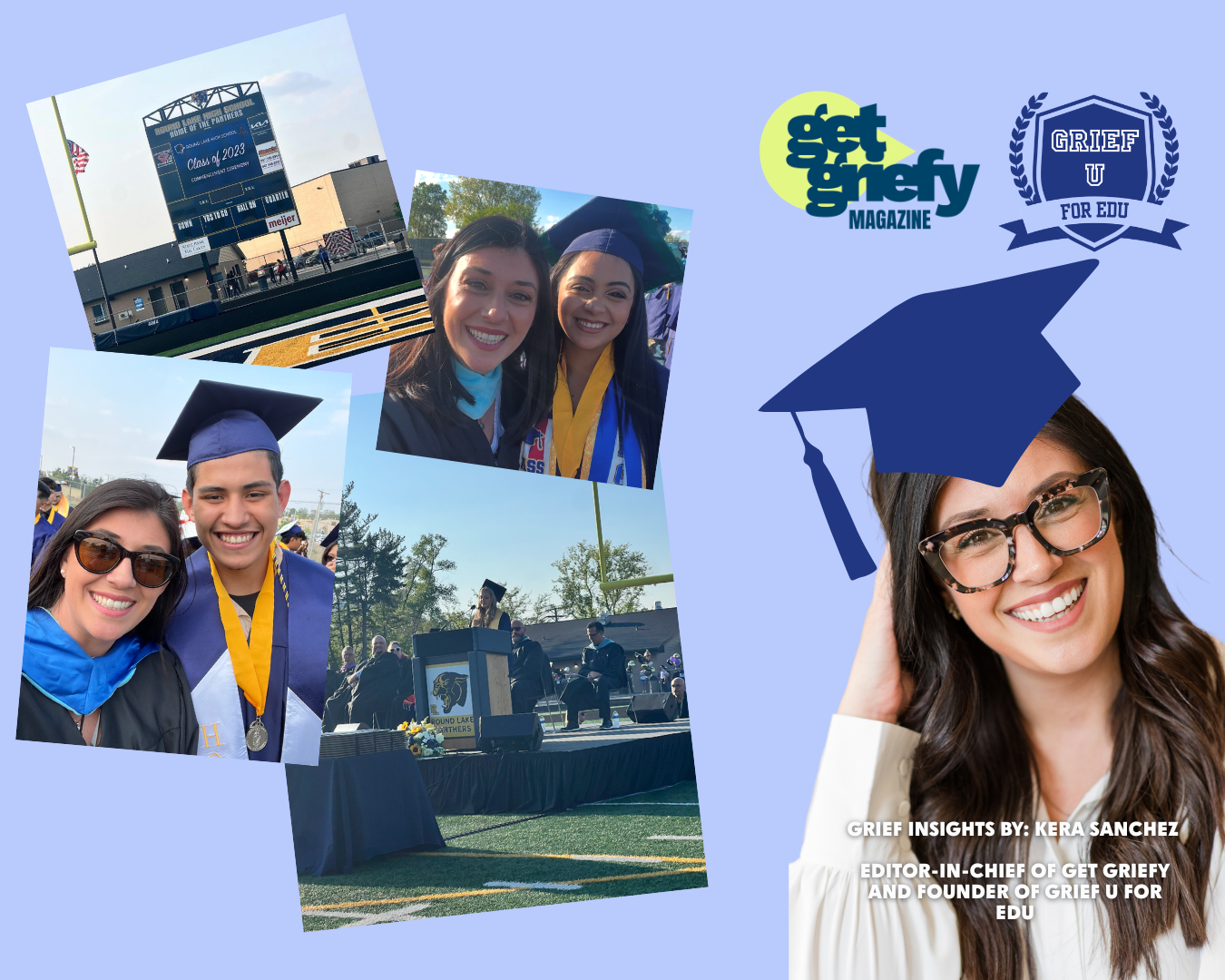
Kera Sanchez comes from a background in Secondary Education where she worked 15+ years as a Spanish Teacher and Dean of Students at Round Lake High School in Illinois.
Growing up, I always equated graduation day with joy — pure, uncomplicated celebration. A day for honoring a milestone that also culminates years of work, effort, and memories. As a teacher, it was one of my favorite duties to attend. I loved wearing my black gown, my baby blue and yellow velvet and silk master’s cape, and the Harry Potter sleeves that — when you have no pockets — serve as the world’s most academic clutch bag. Keys, lip gloss, phone: all accounted for.
But the first time I attended graduation after my mother died, everything shifted.
I looked out at the stadium — hundreds, if not thousands, of people packed in with balloons, flowers, and a buzz of collective pride — and I saw something I had never noticed before. I worked at a school with a large population of immigrant families, and for many, this was the first person in their family to graduate high school, the first to prepare to attend college. I had always seen the joy. That day, I saw the grief woven inside it.
The grief of families separated across borders, of missing members who couldn’t be there. The grief of parents carrying unrealized dreams, watching them finally bloom in their children in real time. I saw the deer-in-headlights look of students for whom high school had been a relentless uphill climb — and this day felt less like a finish line and more like being released into the wild, unsure of which way to run.
I saw the students who had shown up in September with rejection after rejection from the colleges they’d dreamed of, quietly reconciling themselves to a community college plan. Ready to fly, forced to stay put — at least for now.
And then I wondered: how many students were sitting in those seats without a single person there for them? Parents who had to work, no matter what. Parents struggling with addiction, maybe passed out at home on the couch. Students celebrating the biggest day of their young lives, completely alone in a crowd of thousands.
The reality is this: grief exists even on the most momentous and joyful days.
My friend and colleague Nina Rodriguez of The Grief and Light Podcast has a name for this — she calls it Felicitrieza: the experience of grief and happiness coexisting, neither canceling the other out. It is not one or the other. It is both, at the same time, held in the same body, on the same folding chair, under the same May sun.
This is the entire premise behind my program, Grief U for EDU. My work isn’t about turning teachers into therapists. It’s about something far more achievable and far more powerful: developing what I call the sixth sense of grief — the awareness to notice what students are carrying, even when they’re smiling in a cap and gown.
Here’s the thing: you don’t even have to fix it. The act of seeing is enough. When we acknowledge what students carry, when we don’t look away, something shifts in the culture of a school. And that culture — the one built on genuine human awareness — is the same culture that shows up in attendance rates, performance data, and every other metric that the people in charge care about. Grief literacy isn’t soft work. It’s foundational work.
So, hats off to the Class of 2026. We are proud of you, and we see what it took to get here.
If you’re lacking the support you need in this season — if you’re missing someone important, if you’re not sure what comes next, if the celebration feels heavier than it looks — we see you. You are not invisible in your joy, and you are not invisible in your grief.
Grief U for EDU is a professional development workshop and resource hub for secondary educators, grounded in the belief that grief support does not have to be clinical to be effective. Created by Kera Sanchez, Editor-in-Chief of Get Griefy Magazine, the program draws on her 15 years of experience in education as a bilingual secondary educator, Spanish teacher, and Dean of Students.
To learn more, visit griefuforedu.com and follow along on Instagram and LinkedIn. Please share with your educator friends as we work to ensure every school has the resources and training needed to become grief-informed.
