
The Color of My Comeback
By AimeeJo Davis-Varela
It began with a car.
About three months after my wife, Vanessa, died, my car followed suit. It did not die heroically. There was no poetic symbolism. It simply gave up, like, “You seem to be having a hard enough time already. I’m out.”
So, I sold the van we had bought to accommodate her wheelchair and went car shopping – something I was wildly unprepared for, both emotionally and mechanically. While scrolling listings in a kind of numb administrative haze, I saw a purple car.
And I smiled.
I wasn’t doing a lot of smiling in those days, so this felt like a milestone worth noting.
I am one of those widows who almost immediately stopped caring what other people think. (Highly recommend this as a grief side effect.) So, making purple a non-negotiable feature was an easy decision. About a week later, there was a Midnight Amethyst Buick in my driveway, looking like Prince had briefly possessed a sensible, mid-size SUV.
A few months later, my house needed exterior repairs that required painting. I had always hated the yellow-and-brown color scheme it came with, which felt less like a home and more like my dentist’s office in 2004. So, I seized the opportunity.
I chose shades of purple:
Soulmate for the walls. Blackberry for the trim. Kimono Violet for the doors.
If a purple car could make me smile, I figured maybe a purple house could do the same every time I came home in it. This was not a scientifically rigorous plan, but grief is not a scientifically rigorous experience.
It was also the first time I consciously thought: This is mine now.
Widowed at 45, I knew I wasn’t leaving this house. Someday I might share it again. Or not. But either way, I was likely going to spend the next four or five decades here, and it needed to feel like a place where life could keep happening—not just the place where my wife died, where everything felt paused and echoey and like something was missing.
After the house came the fence.
Then the interior walls.
My grandmother’s dresser.
The frame of a Cry Room sign from an old church.
A pair of knee-high boots.
When I ran out of objects large enough to justify painting, I pivoted to acquisition: orchid cushions for the patio, violet gel pens (still the only pens I use—ballpoint and black ink are dead to me), plum office accessories, hair flowers in every shade imaginable, and an alarming number of purple eyeglasses.
To be fair, purple wasn’t new. Our wedding colors were fuchsia and violet, and they’d long been among my favorites. But their presence in our shared life had been moderated by a masc-of-center wife who believed, incorrectly, that not everything needed to be some shade of violet.
She would have rolled her eyes at some of my choices. She would have fought me on others. But as I say about many things now: If she wanted a vote, she should have stuck around.
Two years after her death, I expanded the matching tattoo we’d gotten on a whim at a slightly questionable parlor in Lompoc. Around it, I added fuchsia gerbera daisies like the centerpieces at our wedding, and the tarot cards that kept appearing in readings over the previous year: Death, the Nine of Cups, and the Queen of Swords – the so-called widow card.
Except in my tattooed version, the Queen of Swords has purple hair, her sword is drawn, and she is stepping out of the card, unable and unwilling to be contained by its frame.
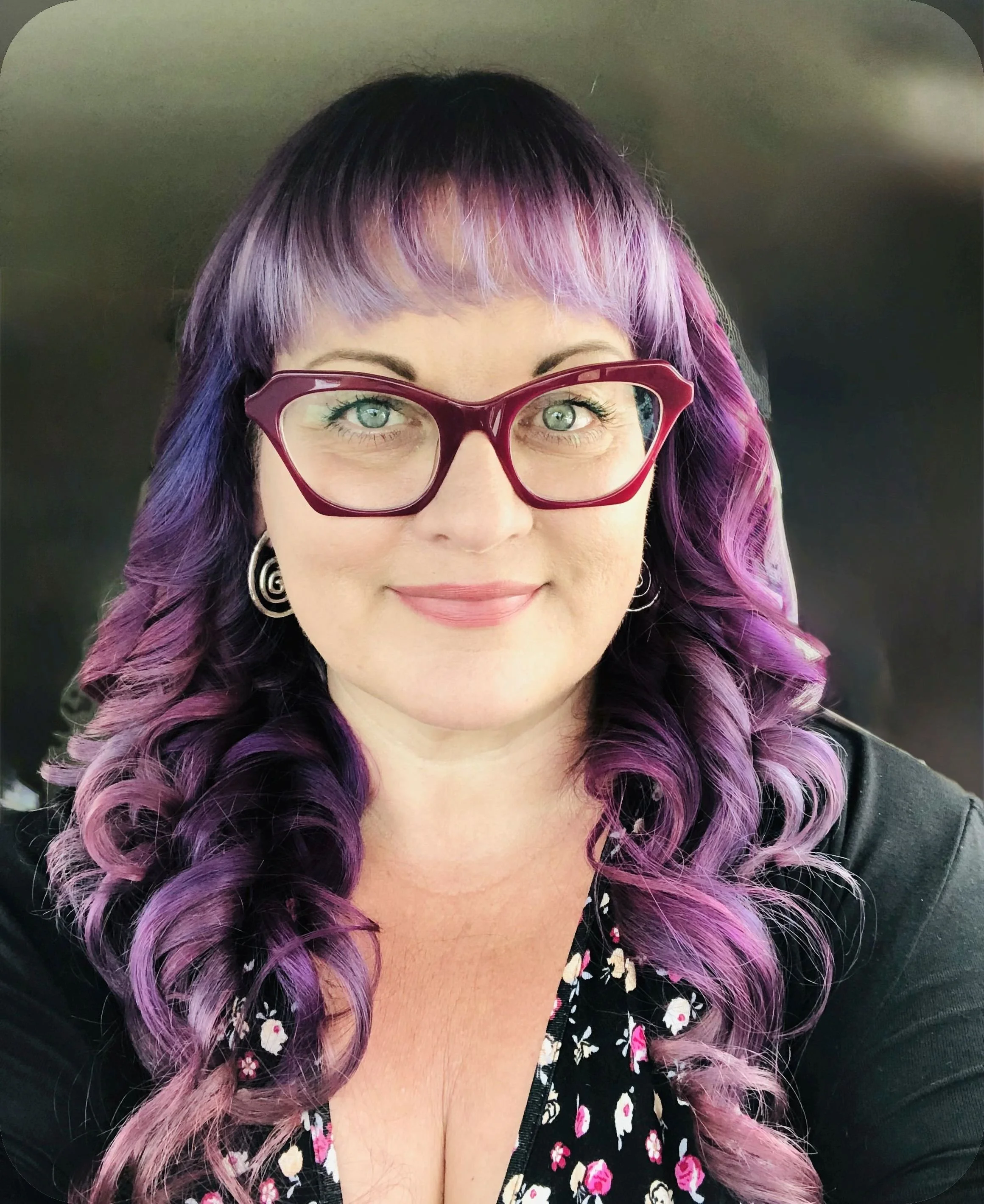
Just after the third anniversary, I dyed my own hair purple.
By then, purple had become something more than a color preference. It was a decision. A declaration. A way of saying: I am still here, and this life – however strange, unexpected, and reshaped – is still mine.
Purple became the color of my comeback.
The color I used to reclaim my space. To mark the beginning of a path I never asked for but am walking anyway. To plant my flag not at the end of grief, but at the summit of the grief mountain I have learned to climb – and carry – with me.
It’s been a little over six years now, and I am repartnered. This is yet another development Vanessa would not have approved of. But – as I have reminded her more than once, usually while talking to the backsplash behind the stove while cooking – if you didn’t want me to date, you shouldn’t have left me here to figure out the rest of life on my own with half of it still ahead of me. I would have gladly stuck to the original plan.
My partner, G, has settled fully into this chapter, which she refers to as The Purpling of Things. She has embraced it with remarkable flexibility for someone who, before meeting me, would never have worn violet or considered Autumn Orchid an appropriate choice for an accent wall. Now she’s the one who spotted the purple sofa in the showroom that found its way into our living room. She never questions the arrival of yet another purple accessory – and she always makes sure her bowtie matches my hair flower.
It turns out grief didn’t end my life. It just changed the color palette.
About the Author
AimeeJo Davis-Varela is a grief educator, resilience coach, writer, and widow, specializing in helping clients integrate grief, increase resilience, navigate secondary losses, and rebuild their lives with joy and purpose, with an emphasis on inclusive support for marginalized communities and disenfranchised grief.
